DAY/DATE
Monday
09/12/2024
SITE/S
Shellacey Reef
Gneering Shoals
PARTICIPANTS
David & Harvey
TYPE
Subtidal
MODE
Boat Dives
VESSEL
Li’l Mischief
DIVE
1
2
SITE/S
Shellacey Reef
Shellacey Reef
SPECIES #
14
21
DURATION
68 Min
71 Min
DEPTH/RANGE
14-16.5 m
14-16 m
TEMP.
22 C
22 C
VIS.
Up to 12 m
Up to 12 m
SURGE
Slight
Slight
CURRENT
Slight
Nil
COMMENTS & OBSERVATIONS
Once again it has been quite awhile since Li’l Mischief was pitted against the waves. Wind, swell and surface obligations saw to that. However, a tiny window of opportunity presented itself on Monday and off we went. The trailer park at the La Balsa ramp was quiet. Given the recent rainfall/runoff it was only ever the Outer Gneering Shoals as a suitable destination. It has been almost 2 years since our last survey of Shellacey Reef so we set course for that topographically delightful dive site. Our speed out was reduced to 15 knots with the short head-on chop. We weren’t disappointed with our choice of dive site recording 35% more species than the last double survey there. Our return trip with the following sea allowed a steady speed of 30 knots, “blowing all the cobwebs” out of the underused outboard engine.
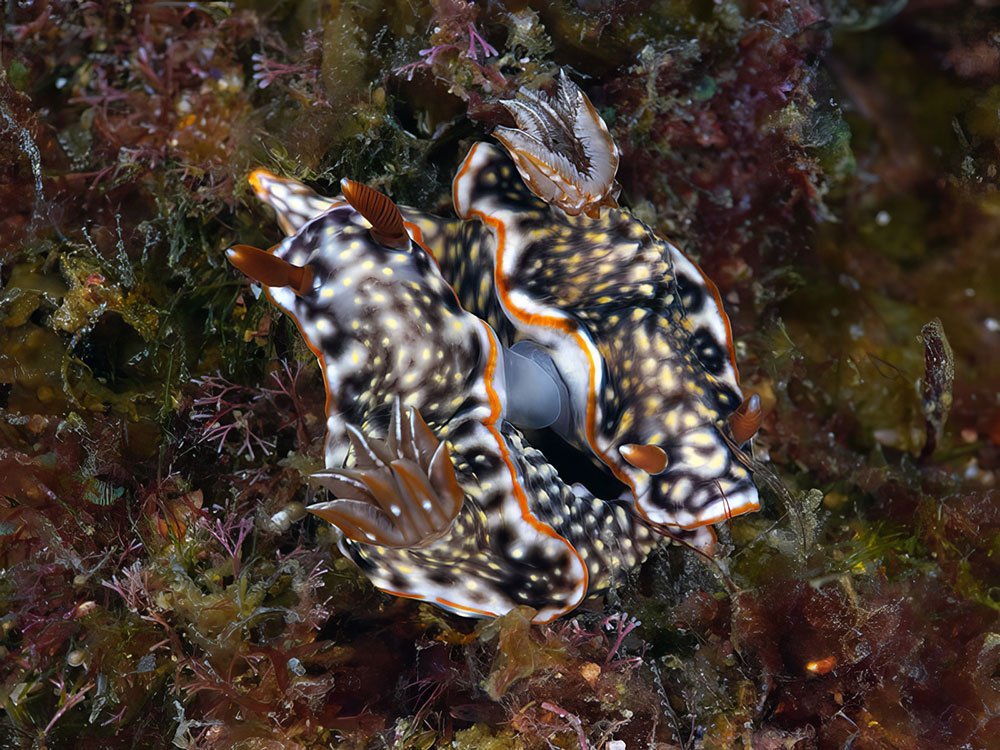
During the first dive we noticed a gradual increase in the current on the bottom but otherwise the conditions were pleasant. We covered more territory on the second dive (less current) which is reflected in the species numbers recorded. The aeolids were especially small and challenging to both find and to capture a decent image of. Finds of note include: Miamira sinuata, Ceratodoris hallucigenia and Thorunna sp. 07. During the safety stops we both sighted a different specimen of pelagic sea-butterfly, but we were caught unprepared and missed a photographic opportunity. Normally when sighted there are dozens passing by and one can prepare to record something of the parade, but we each only observed the one. It is quite possible they were Cavolinia uncinata that we have recorded previously, but without collecting and examining the shell could not be certain, so therefore have placed in the Species List as Cavoliniidae sp. and omitted from any stats. One other interesting find is a Syllidae worm recorded by Harvey. At first glance it would appear to be a type of Tergipes nudibranch which has a single ceras in each row. The animal also did not exhibit chaetae that would be be expected in this type of worm. A little research brought to light a recent paper on “nudibranch-mimicking Syllidae” that possess cerata-like dorsal cirri and hidden (retractable) hooked chaetae.
Taxonomic Diversity:
Twenty-four of the twenty-seven sighted species were nudibranchs, with 19 being dorids comprising 2 x phanerobranchs (non-retractile gill), 3 x porostomes (suctorial feeders – all of the Phyllidiidae family), 14 x cryptobranchs (retractable gill – all 14 belonging to the Chromodorididae family) and 5 were cladobranchs comprising 4 x aeolids, 1 x arminid and 0 x dendronotinids. A single sacoglossan (sap-suckers) and 2 x cephalspideans (headshield slugs) complete the species count. If diet is considered than 18 of the 27 species sighted are spongivores. More than 54 specimens in total were recorded.
Our Historical Data:
– This excursion brings the number of survey dives to 70 at Shellacey Reef since we commenced fully recording data here on 26/01/2010.
– 185 species have been recorded at this site.
– Our most commonly recorded species at Shellacey Reef are Chromodoris elisabethina (91%), Doriprismatica atromarginata (84%), Phyllidiella pustulosa (84%) and Thuridilla cf. splendens (67%).
– This is the first time we have recorded Cratena sp. 03, Micromelo barbarae or Tenellia sp. 20 at this site.
– Interestingly, we last recorded Cratena sp. 03 in the Mooloolah River on 3/12/2019 and have not recorded it offshore previously.
– The graph, in the image gallery below, shows that the number of species and organisms recorded in any survey dive has remained relatively constant over the period we have been conducting surveys here.
– Our last survey at Shellacey Reef was on 10/01/2023.
(Historical data courtesy of Terry Farr, who extracts it from his comprehensive database.)
Key to symbols
+++ New Species
+ First time sighted at this site
# Most commonly sighted at this site with %
TOTAL SPECIES SIGHTED: 27
SPECIES LIST – ALPHABETICAL
Aegires flores -/3
Ardeadoris rubroannulata -/2
Cavoliniidae sp. 1/1
Ceratodoris hallucigenia 1/-
Chromodoris elisabethina 4/2 #91%
Chromodoris kuiteri 1/1
Cratena lineata 2/1
Cratena sp. 03 1/1 +
Dermatobranchus rodmani 2/-
Doriprismatica atromarginata 1/1 #84%
Goniobranchus geometricus -/1
Goniobranchus sp. 07 1/-
Goniobranchus splendidus -/1
Hypselodoris jacksoni 2/1
Hypselodoris maritima 1/-
Hypselodoris obscura 1/-
Hypselodoris whitei 1/-
Mariaglajia inornata -/1
Mexichromis trilineata -/1
Miamira sinuata -/1
Micromelo barbarae -/1 +
Phyllidia elegans -/2
Phyllidia varicosa -/1
Phyllidiella pustulosa 2/4 #84%
Samla bicolor -/1
Tenellia sp. 20 -/1 +
Thorunna sp. 07 -/1
Thuridilla cf. splendens 3/3 #67%
SPECIES GROUPED BY ORDER
Nudibranchia
Dorids
Phanerobranchs
Aegires flores -/3
Ceratodoris hallucigenia 1/-
Cryptobranchs
Ardeadoris rubroannulata -/2
Chromodoris elisabethina 4/2
Chromodoris kuiteri 1/1
Doriprismatica atromarginata 1/1
Goniobranchus geometricus -/1
Goniobranchus sp. 07 1/-
Goniobranchus splendidus -/1
Hypselodoris jacksoni 2/1
Hypselodoris maritima 1/-
Hypselodoris obscura 1/-
Hypselodoris whitei 1/-
Mexichromis trilineata -/1
Miamira sinuata -/1
Thorunna sp. 07 -/1
Porostomes
Phyllidia elegans -/2
Phyllidia varicosa -/1
Phyllidiella pustulosa 2/4
Cladobranchs
Aeolids
Cratena lineata 2/1
Cratena sp. 03 1/1
Samla bicolor -/1
Tenellia sp. 20 -/1
Arminids
Dermatobranchus rodmani 2/-
Dendronotinids
–
Cephalaspidea
Mariaglajia inornata -/1
Micromelo barbarae -/1
Pteropoda
Cavoliniidae sp. 1/1
Sacoglossa
Thuridilla cf. splendens 3/3
Umbraculoidea
–
Pleurobranchoidea
–
Anaspidea
–
DIVE IMAGES GALLERY
PUT CURSOR ON IMAGE FOR SPECIES NAME
CLICK IMAGE TO ENLARGE & SCROLL